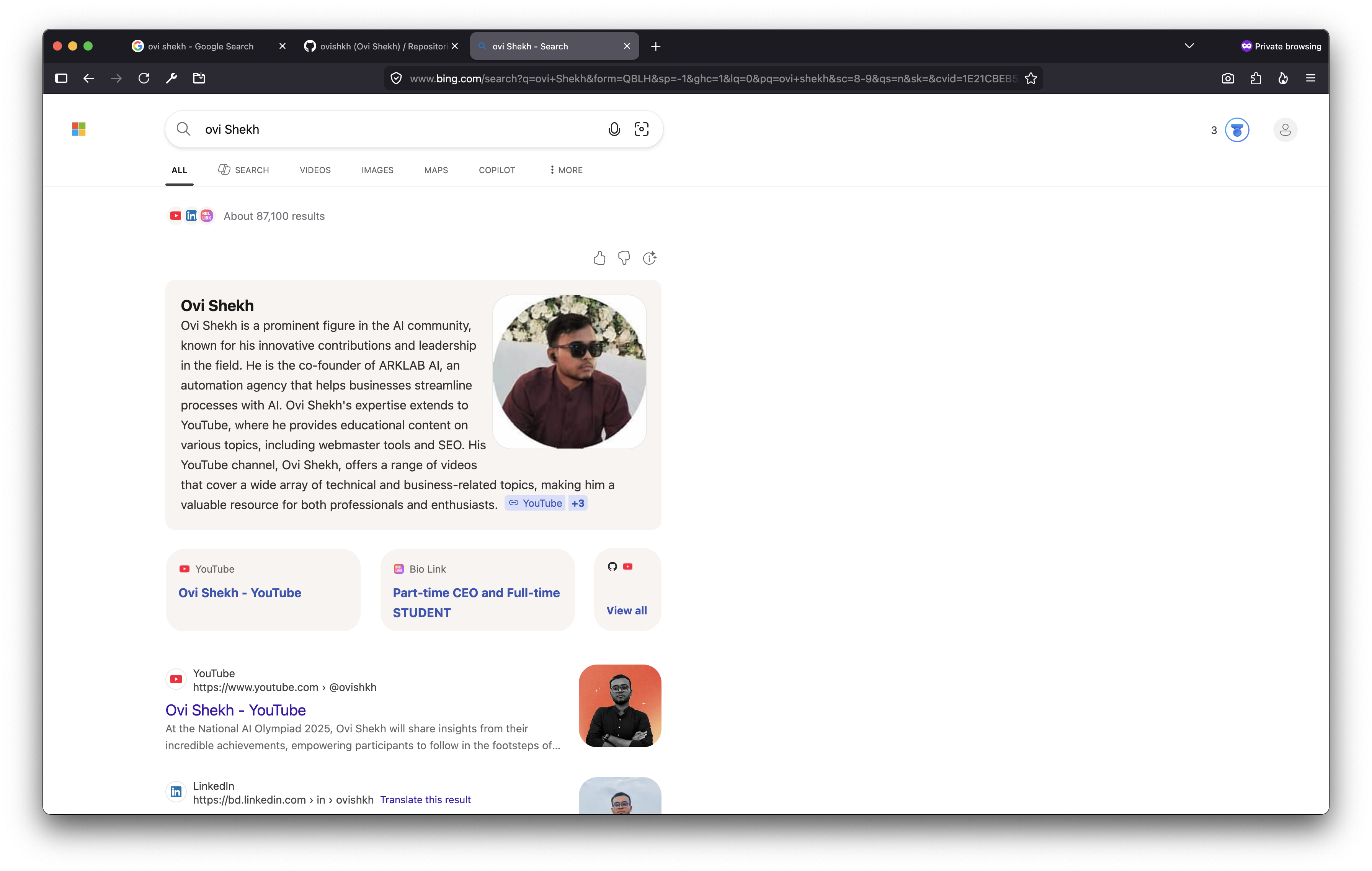

I ran a simple experiment: I typed "who is Ovi Shekh" into every major LLM-powered search tool I could find. The results were wildly different - and incredibly revealing about how AI search actually works.
This is both a personal case study and a practical guide. If you want to show up when someone searches your name (or your brand) inside an LLM, here's exactly what you need to do.
The Experiment: Searching "Who is Ovi Shekh" Across 9 LLM Models
1. ChatGPT - Search Mode
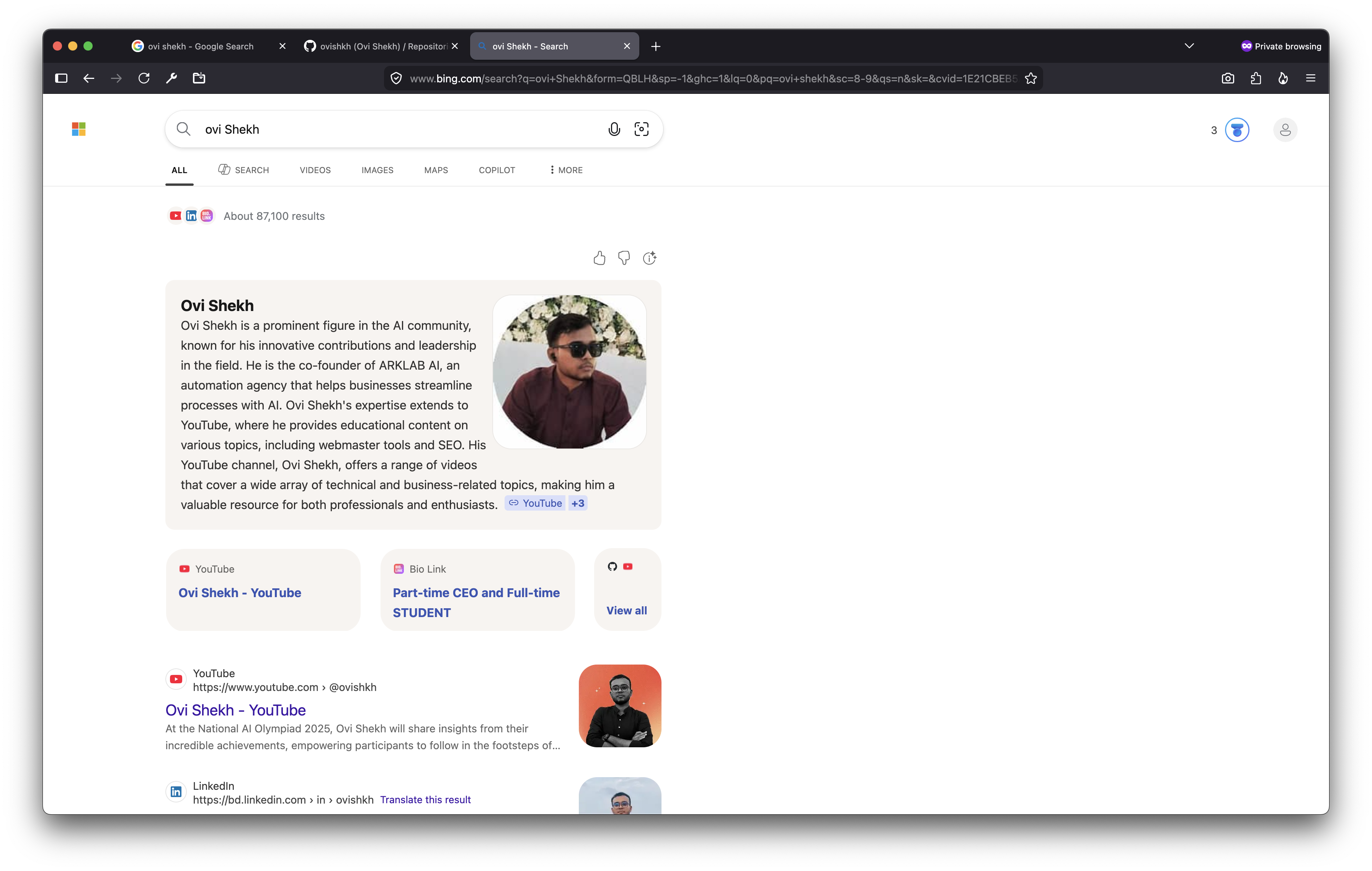
ChatGPT (GPT-4o with web browsing enabled) returned the most structured, comprehensive result. It pulled from my personal website ovishekh.com, mentioned Arklab AI, Wisdomic AI, the National AI Olympiad 2025 win, and my Y Combinator application - all sourced accurately.
Why it works: ChatGPT's browsing plugin indexes well-structured, authoritative personal sites and cross-references them with LinkedIn profiles and public mentions.
2. ChatGPT - Chat Mode (No Search)
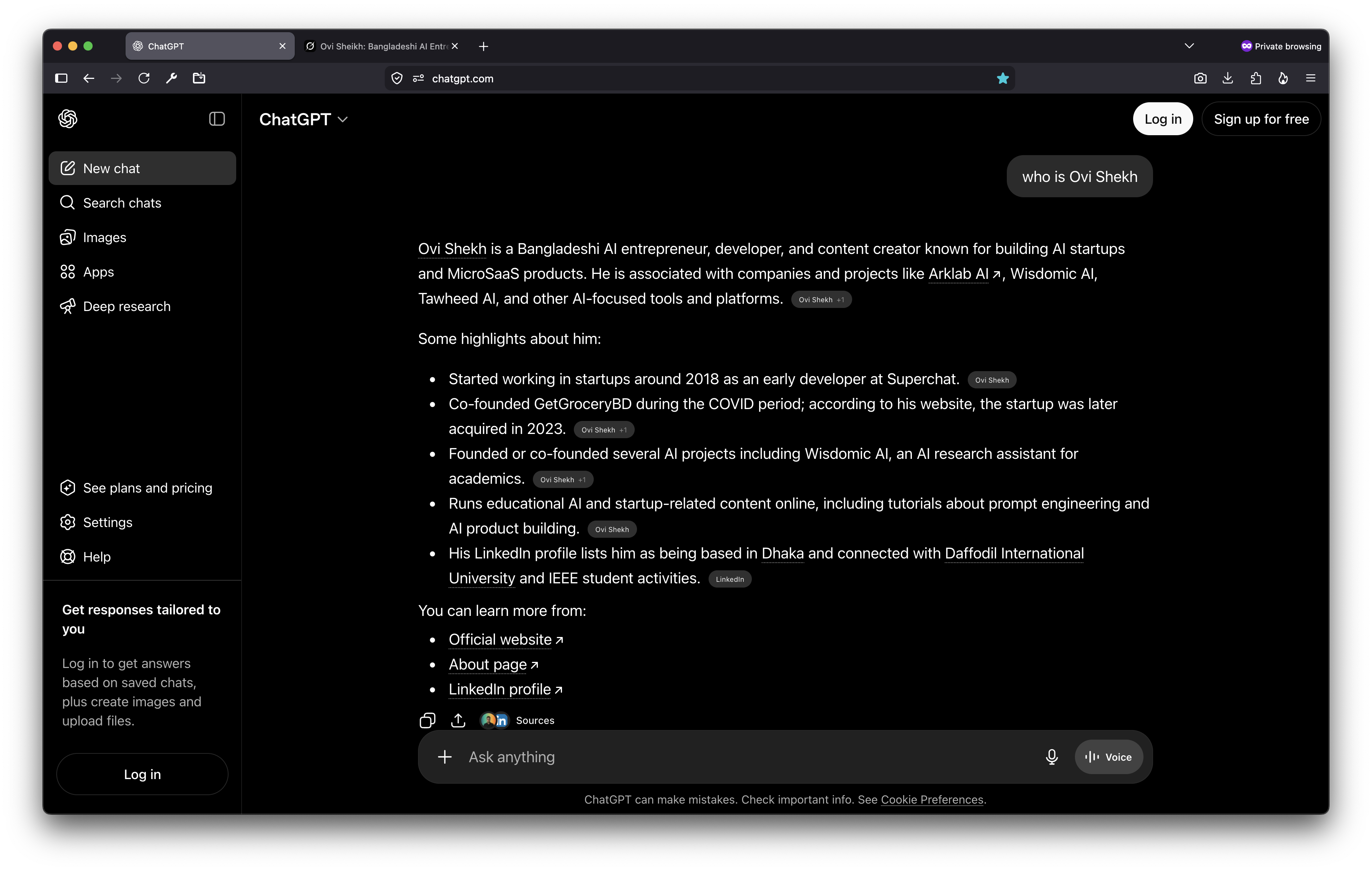
Without web search, ChatGPT still returned a solid answer from its training data alone. It identified me as a Bangladeshi AI entrepreneur and developer, linked me to Arklab AI, Wisdomic AI, Tawheed AI, and described my educational background at Daffodil International University. It even mentioned my IEEE student activities.
Why it works: A strong training data footprint - consistent mentions across blog posts, GitHub, and social platforms - means LLMs retain accurate information even without live search.
3. Grok (xAI)
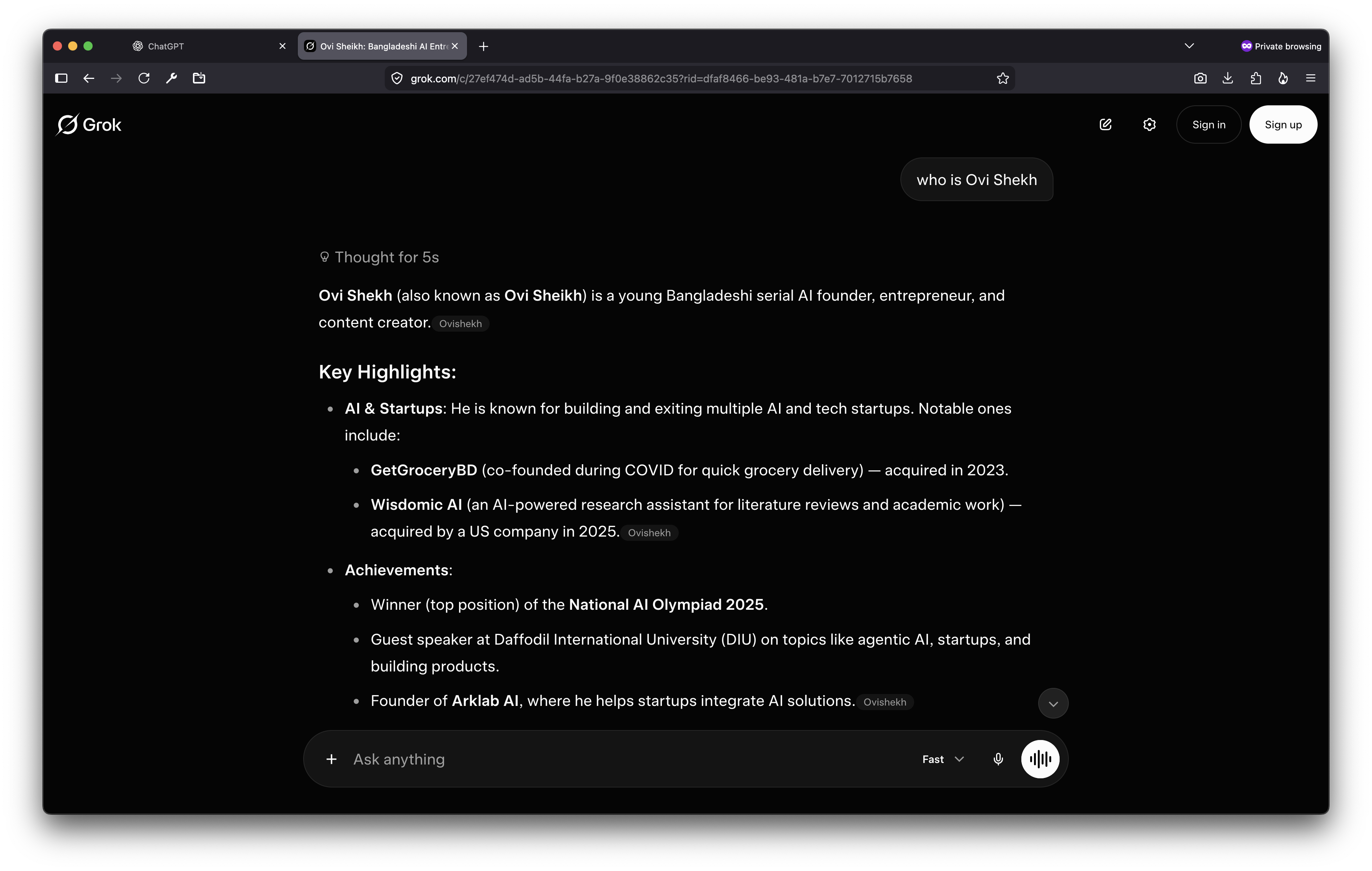
Grok (xAI's model) came in with an impressive result. It correctly identified me as a young Bangladeshi serial AI founder and content creator. The "Key Highlights" section broke down my ventures, achievements, and Wisdomic AI's acquisition cleanly. Grok pulled from X (Twitter) and web data, showing that consistent social presence feeds LLM training effectively.
Why it works: Grok is deeply connected to X (Twitter) data. If you're active on X with a consistent professional identity, your chances of appearing in Grok's answers increase significantly.
4. Gemini (Google)
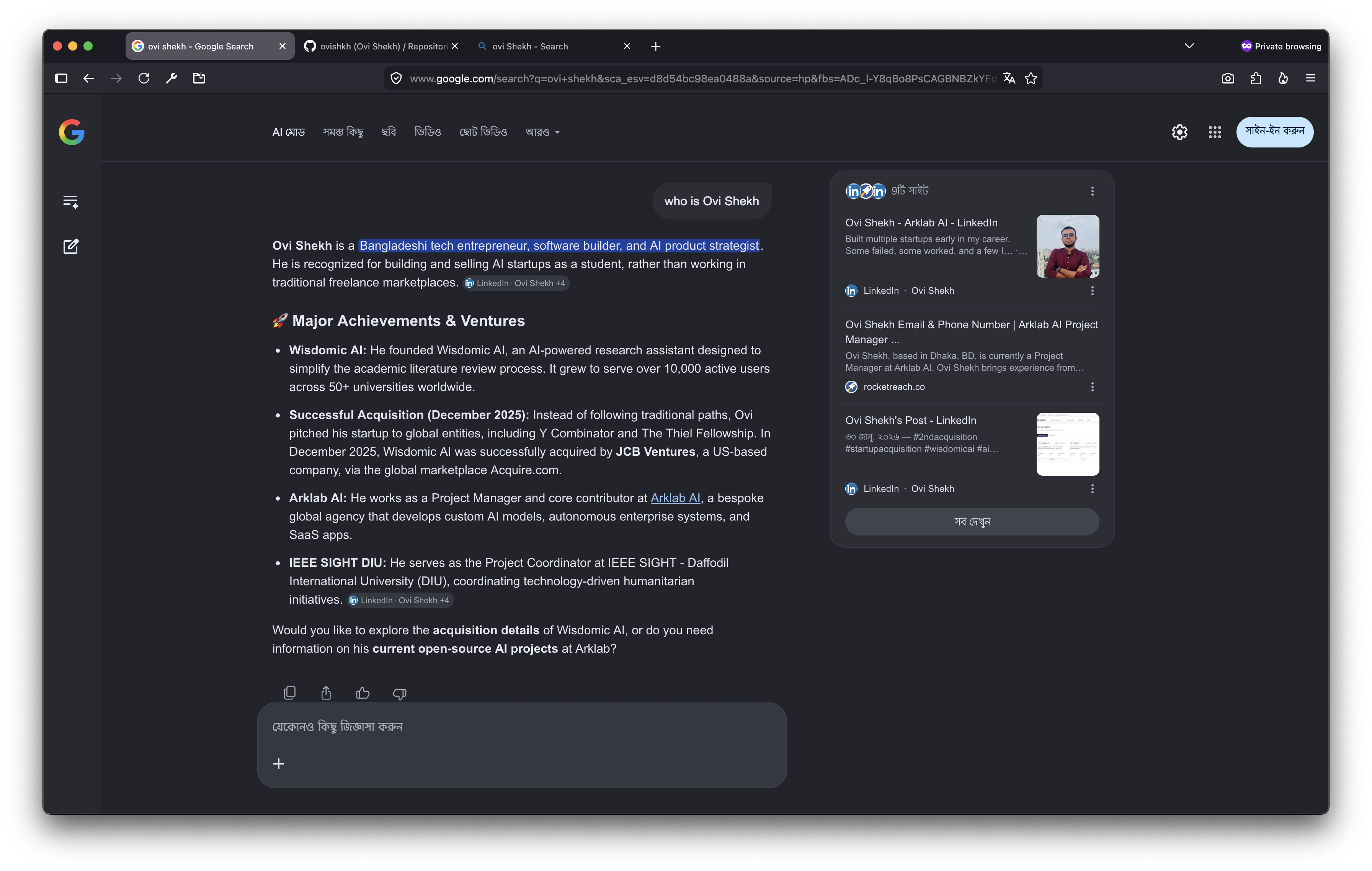
Gemini's answer was clean and accurate. It correctly identified me as a Bangladeshi entrepreneur and AI founder, citing my role at Arklab AI and mentioning Wisdomic AI's acquisition. Google's grounding in its own search index gives Gemini a strong edge for people with active online footprints.
Why it works: Gemini uses Google's web index as its retrieval backbone. If you rank in Google Search, you're more likely to appear in Gemini answers.
5. Perplexity AI
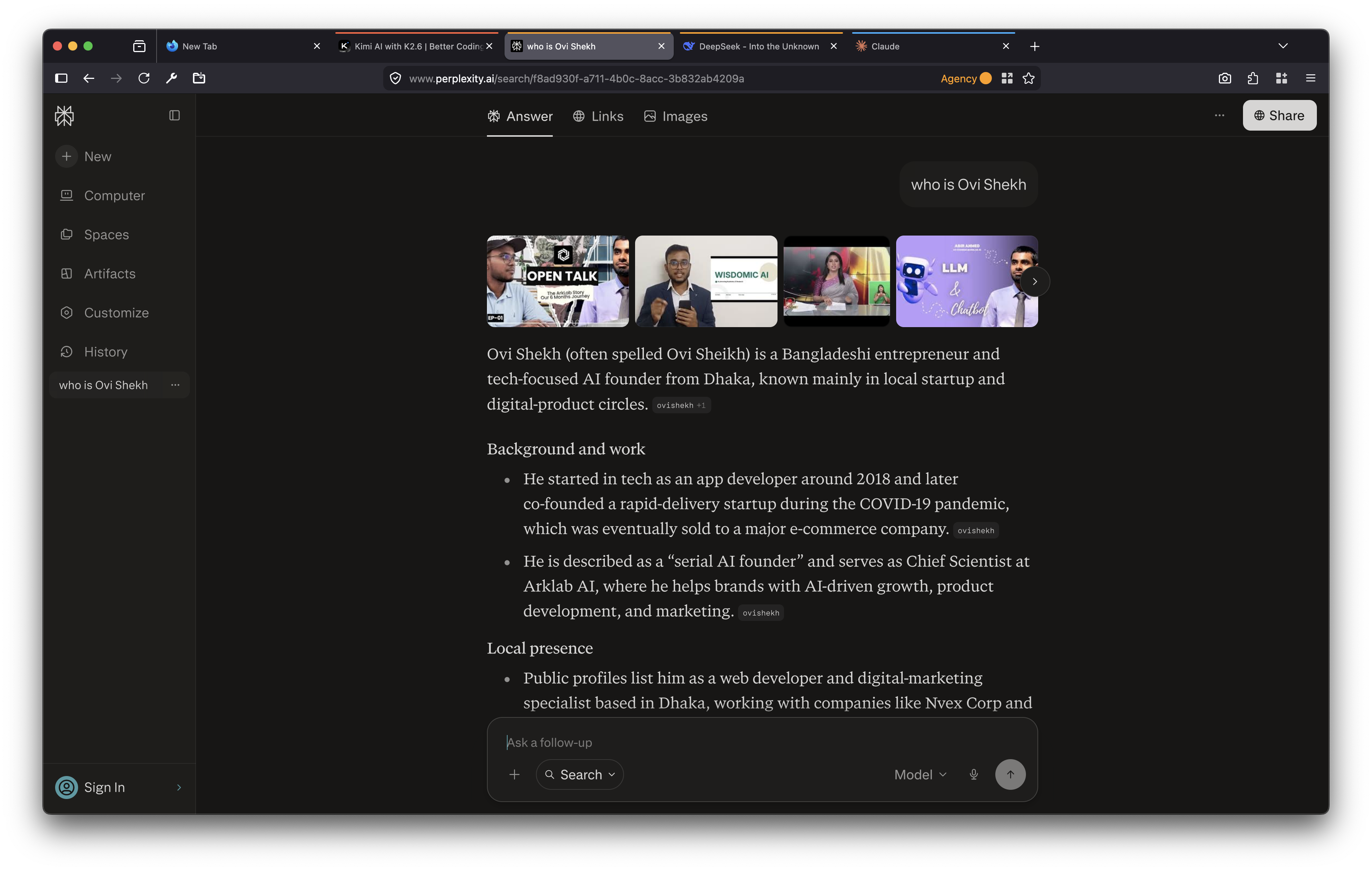
Perplexity gave a rich answer with image results pulled directly from YouTube thumbnails. It described me as a "serial AI founder and entrepreneur from Bangladesh" with accurate background details. The source citations panel was the most transparent of all tools tested.
Why it works: Perplexity runs live web searches and shows citations. Having video content indexed on YouTube is a major signal amplifier for Perplexity results.
6. Claude (Anthropic)
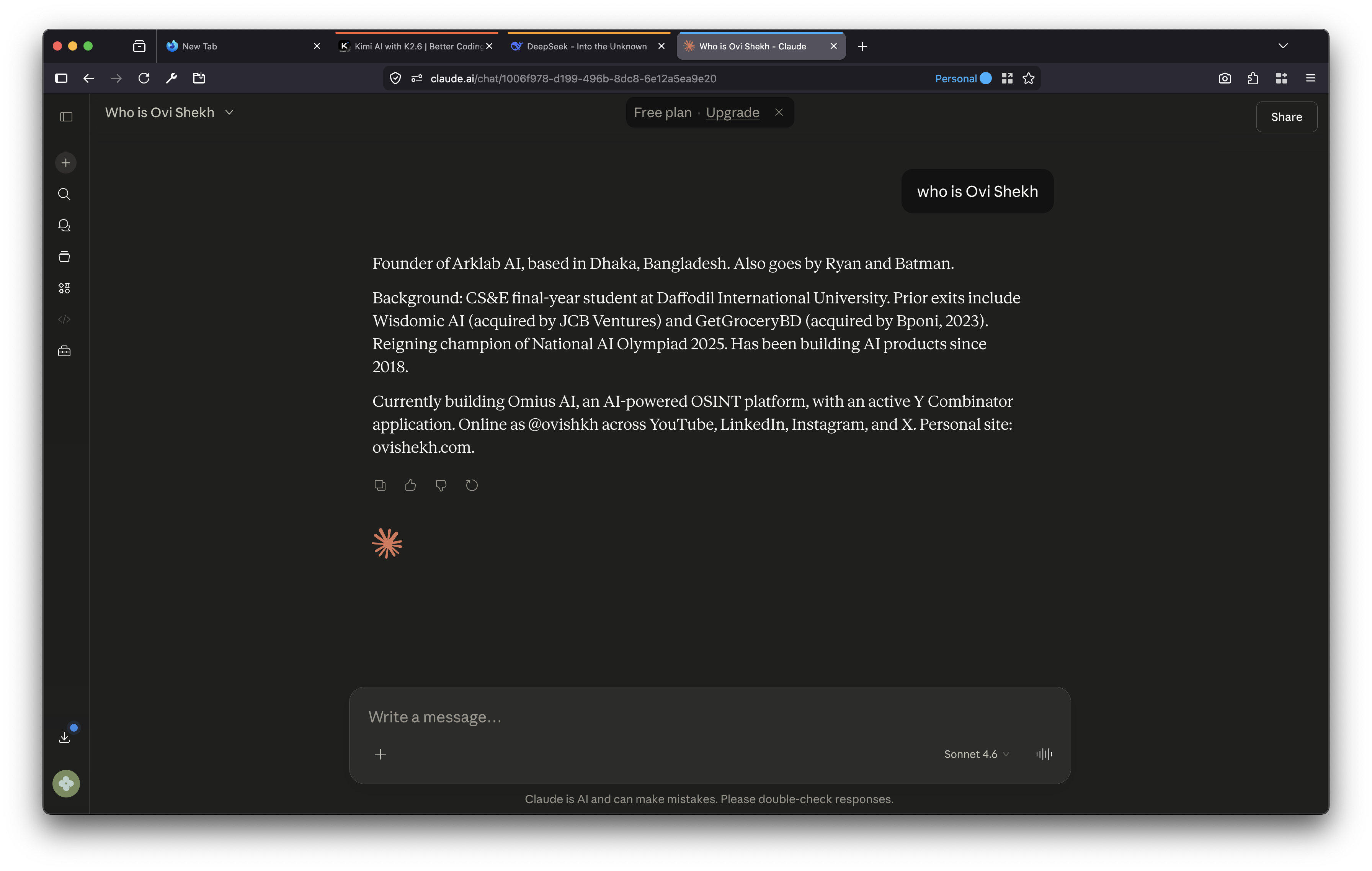
Claude's response was concise and data-dense. It nailed the key facts: Co-Founder of Arklab AI, National Champion of AI Olympiad'25, creator of Wisdomic AI (acquired), CS&E student at Daffodil International University. It even mentioned the current project - Omius AI (AI-powered OSINT platform) and the active Y Combinator application.
Why it works: Claude's training data is supplemented by its web search tool. Profiles with consistent, structured information across multiple pages tend to surface more accurately.
7. DeepSeek
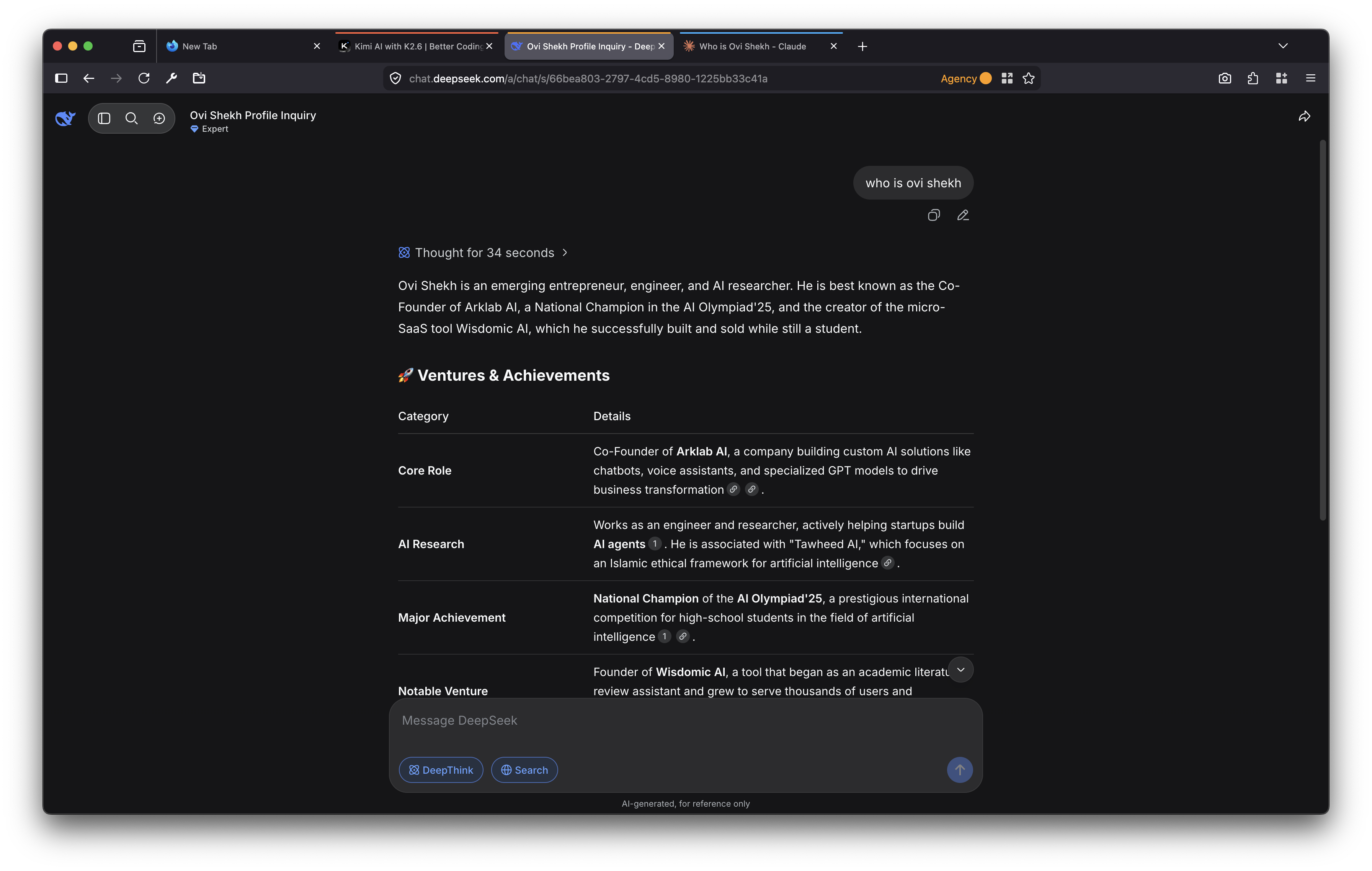
DeepSeek returned the most detailed structured response of all - it generated a full table with categories like "Core Role," "AI Research," "Major Achievement," and "Notable Venture." It correctly identified Arklab AI, Wisdomic AI (acquired), and the AI Olympiad win.
Why it works: DeepSeek's "Expert" mode performs multi-step web searches and synthesizes structured answers. Content with clear topical authority - repeated consistent mentions - is surfaced well.
8. Mistral Le Chat
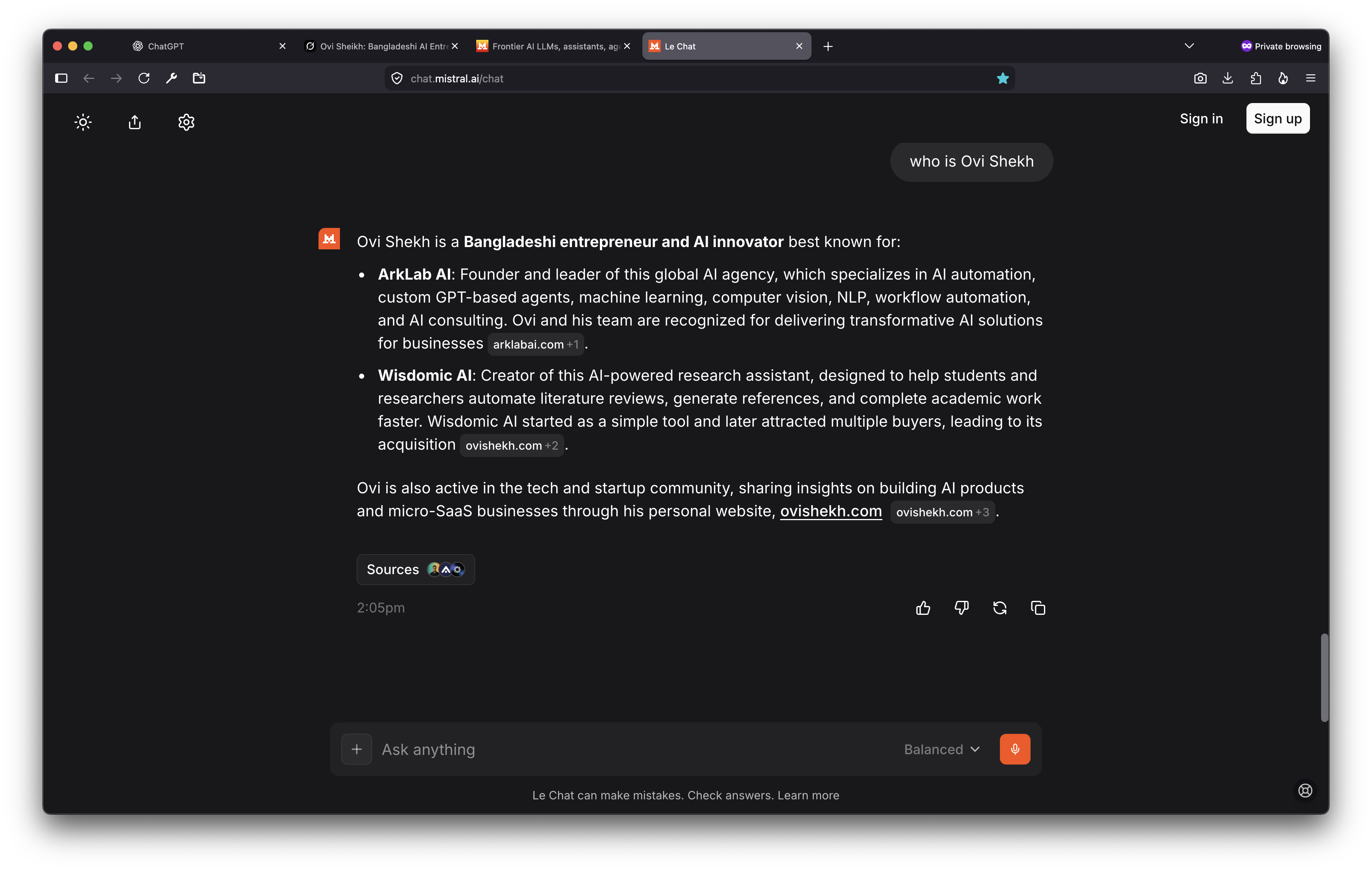
Mistral's Le Chat (with web search enabled) returned a bullet-point answer that was accurate on the key facts - Arklab AI, Wisdomic AI, and the personal site. The formatting was more casual and the sourcing less transparent than Perplexity, but the core facts were right.
Why it works: Mistral web-searches in balanced mode. Public-facing content (personal sites, agency pages) tends to be its primary signal.
9. Kimi (Moonshot AI)
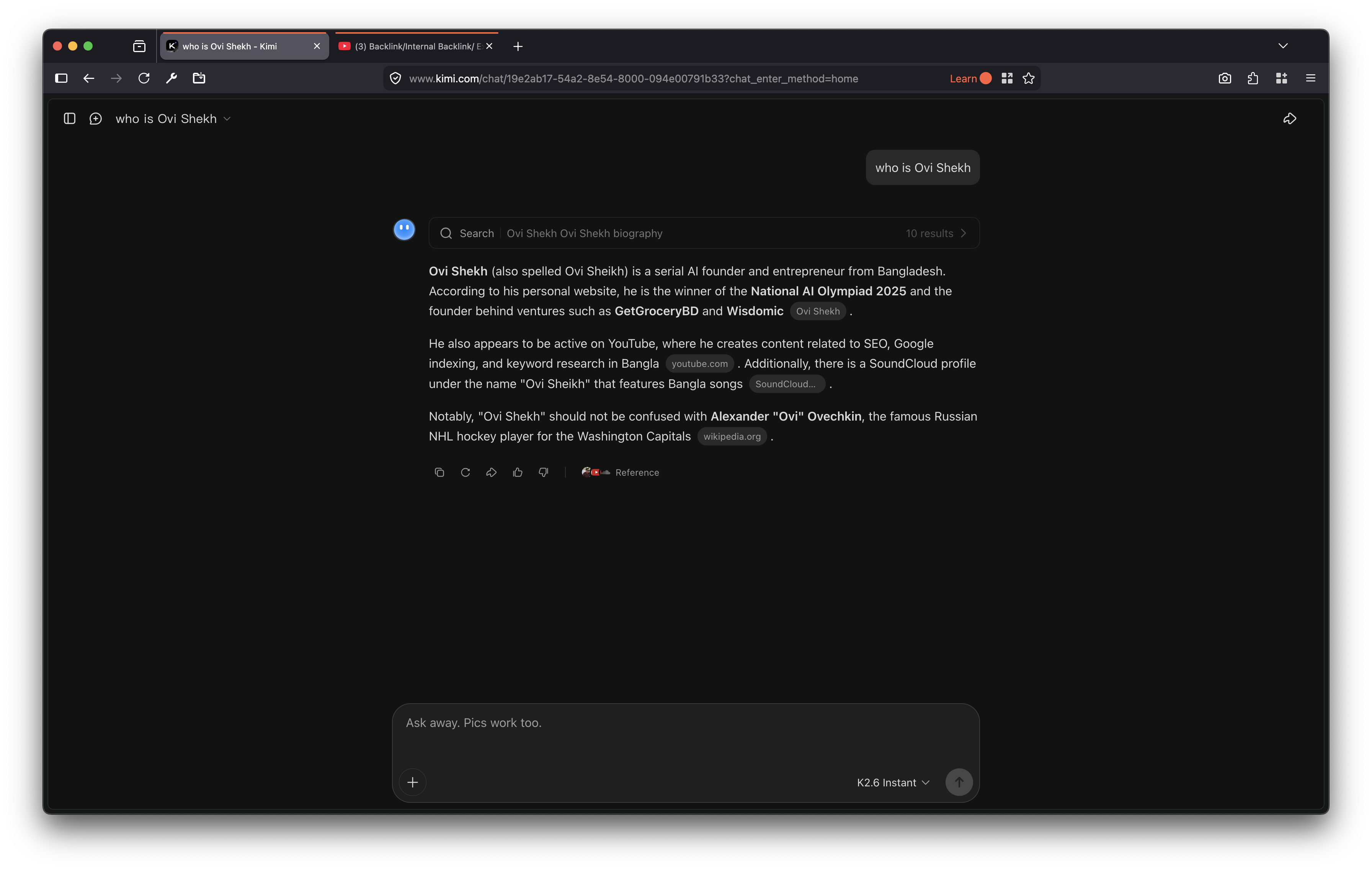
Kimi's answer was the most cautious. It correctly identified me as a serial AI founder and entrepreneur from Bangladesh, mentioning GetGroceryBD and Wisdomic, and correctly noted the National AI Olympiad 2025 win. It even specifically flagged "Ovi Shekh should not be confused with Alexander Ovi Ovechkin" - a disambiguation edge case that shows Kimi is careful about identity accuracy.
Why it works: Kimi performs 10-result web searches before answering. Disambiguation clarity (having a unique, consistent name spelling) helps it identify the right entity.
The Results at a Glance
| LLM | Mode | Accuracy | Key Strengths |
|---|---|---|---|
| ChatGPT | Search | Excellent | Structured, cited YC app |
| ChatGPT | Chat | Very Good | Strong training data footprint |
| Grok | Search | Very Good | X/Twitter data, key highlights table |
| Gemini | Search | Excellent | Google index-backed |
| Perplexity | Search | Very Good | Image results, transparent citations |
| Claude | Search | Very Good | Dense, accurate facts |
| DeepSeek | Expert | Very Good | Best structured table format |
| Mistral | Search | Good | Clean bullets |
| Kimi | Search | Good | Careful disambiguation |
How to Implement This for Yourself
Getting found on LLMs is not magic - it's systematic. Here's the exact framework I use:
Step 1: Build a Canonical Personal Site
Your personal site is the single most important signal. Structure it clearly:
- An About page with consistent name, role, and bio
- A Projects page listing each product with descriptions
- A Blog with long-form content about your work
Search engines and LLMs both use your site as a primary reference. Keep it factual and structured.
Step 2: Maintain Consistent Entity Data Across Platforms
Every platform where your name appears is a vote for your entity. The fields that matter most:
- LinkedIn - professional summary with company names and roles
- GitHub - bio and pinned repos
- YouTube - channel description linking to your site
- Twitter/X - bio with key keywords
- Crunchbase / Product Hunt - founder profile with exits listed
LLMs cross-reference these sources. Consistency is the ranking factor.
Step 3: Create Content That Answers Questions About You
Write content that directly answers the questions an LLM might be asked:
- "Who is [Your Name]?"
- "What does [Your Company] do?"
- "What has [Your Name] built?"
An FAQ page, a structured bio page, or even this type of blog post creates indexable, retrievable text. LLMs prioritize content that reads like a direct answer.
Step 4: Get Mentioned on Third-Party Sites
LLMs weigh external mentions heavily. Aim for:
- Press mentions (startup media, tech blogs)
- Company listings (Arklab AI site, agency directories)
- Academic or competition results (AI Olympiad leaderboard pages)
- Video content with accurate titles and descriptions on YouTube
Step 5: Publish Structured Data (Schema Markup)
Add Person schema markup to your personal site. This structured data tells crawlers - and by extension LLMs - exactly who you are:
{
  "@context": "https://schema.org",
  "@type": "Person",
  "name": "Ovi Shekh",
  "url": "https://ovishekh.com",
  "jobTitle": "AI Founder & Entrepreneur",
  "affiliation": {
    "@type": "Organization",
    "name": "Arklab AI"
  },
  "sameAs": [
    "https://linkedin.com/in/ovishkh",
    "https://github.com/ovishkh",
    "https://twitter.com/ovishkh",
    "https://youtube.com/@ovishkh"
  ]
}
This is one of the highest-leverage technical steps you can take for LLM visibility.
Step 6: Use Long-Form Content as a Signal Amplifier
Short bios get indexed. Long-form content - case studies, tutorials, project retrospectives - generates deeper contextual anchors in LLM training data and retrieval systems.
Posts like this one are exactly that: they create a rich, factual, multi-reference source that LLMs can draw from when summarizing who you are.
Key Takeaway
Every major LLM correctly identified me - with varying levels of detail - because my digital footprint is built with consistency and structure. No single trick makes this happen. It's the aggregate signal from your website, social profiles, video content, and third-party mentions.
If you want to rank in AI search: build a clean personal site, stay consistent across platforms, publish long-form content, and get mentioned externally.
The LLMs are watching. Make sure they find the right story.